On the water you get the sun twice — once from overhead and again off the surface. That's why a helm under a hardtop on Santa Rosa Sound in July can feel hotter than a parked car, and why boat glass is some of the most worthwhile film there is.
Why boat glass takes such a beating
- Double sun. Direct sun plus reflection off the water hits the helm from angles a car windshield rarely sees.
- Glare. Late-afternoon light off the water on the run home is the hardest light to drive a boat into.
- UV on everything. Seats, vinyl dash tops and the screens on your electronics fade, crack and wash out. Film blocks nearly all of the UV.
- Salt. Spray dries into a crust on every surface, which is brutal on cheap film.
First question: is it glass or plastic?
This decides everything else. Plenty of boats have real glass in the windshield or cabin, but many use acrylic (Plexiglas) or polycarbonate (Lexan) — especially hatches, portlights and some hardtop and enclosure panels.
Standard window film is made for glass. Plastic glazing absorbs moisture on humid days and releases it as it dries — outgassing — and that vapor gets trapped under film and lifts the adhesive into blisters. Worse, once film fails on soft plastic it's hard to remove without scratching the panel. There are films engineered for plastic glazing, but every quote has to start by identifying what each window is actually made of.
Clear vinyl enclosure curtains — the roll-up "isinglass" on a lot of center consoles and pontoons — are a different product again. Window film isn't made for flexible vinyl.
Is there a tint law for boats in Florida?
Florida's window tint statute, sections 316.2951 to 316.2957, is written for motor vehicles on public roads, and it doesn't set shade limits for boats. (The truck towing it is another matter — see our Florida window tint law guide.)
That doesn't make "as dark as possible" the right call. The Navigation Rules require every vessel to keep a proper lookout by sight and hearing at all times — Rule 5 — and a dark forward windshield is the last thing you want coming back in at dusk or picking out channel markers in haze. A sensible split: light ceramic film on the glass you look through from the helm, darker film on cabin and side glass where forward visibility doesn't depend on it.
Why ceramic is worth it on a boat
Dyed film fades and turns purple fastest in hard sun, and there's no harder sun than on the water. Ceramic film gets its heat rejection from ceramic particles rather than dye, so it holds its color — and because it contains no metal, it won't interfere with GPS, VHF or phone signals. The full comparison is in ceramic vs. carbon vs. dyed.
The marine film we install is backed by a lifetime warranty against bubbling, peeling and purpling — which is exactly the environment where that warranty earns its keep.
Caring for tinted boat windows
- Rinse before you wipe. Fresh water first — dried salt crystals act like sandpaper under a towel.
- Soft microfiber and ammonia-free cleaner. Ammonia breaks down film adhesive; abrasive pads scratch.
- Let new film cure. A little haze or a few small water pockets right after an install are normal while it cures — here's what to expect and for how long.
At the marina, the lift or your driveway
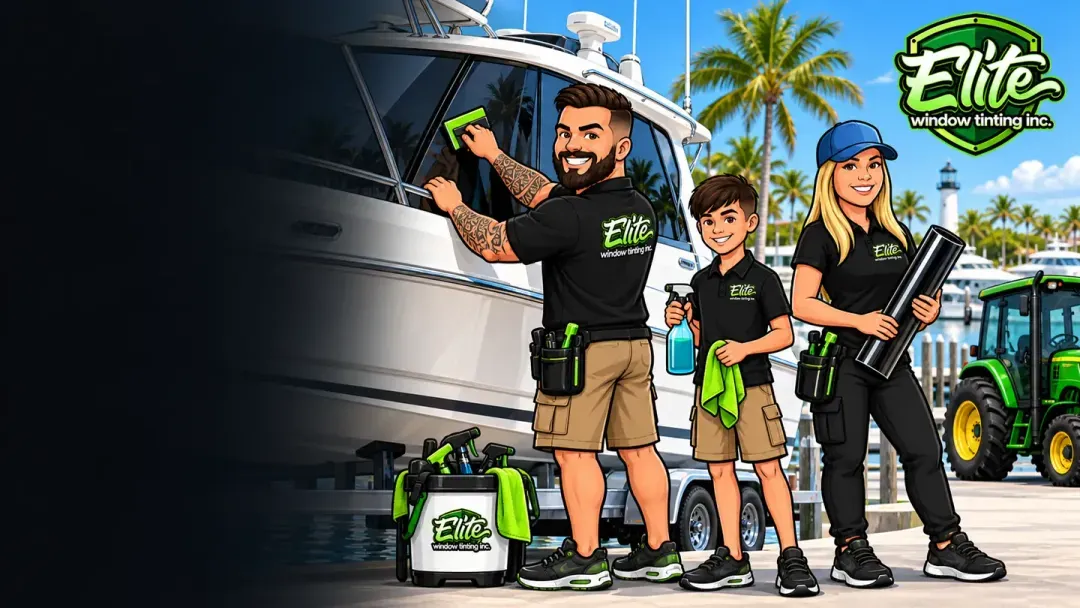
We come to the boat: marina slip, boat lift or driveway anywhere from Navarre to Pensacola, Fort Walton Beach and Destin, seven days a week, with no travel charge. Film goes on cleanest out of the wind and blowing sand, so we'll work out the spot and the time with you.
The same crews tint tractor cabs, skid steers, golf carts and side-by-sides — see marine, tractor and equipment tinting.
Getting a price
Text photos of each window you want done, plus the make, model and length of the boat — and whether the panels are glass or plastic, if you know. We'll quote it flat, usually within the hour.
Boat glass cooking the helm? Text photos to (850) 930-1195. Get a free quote · Call / text (850) 930-1195