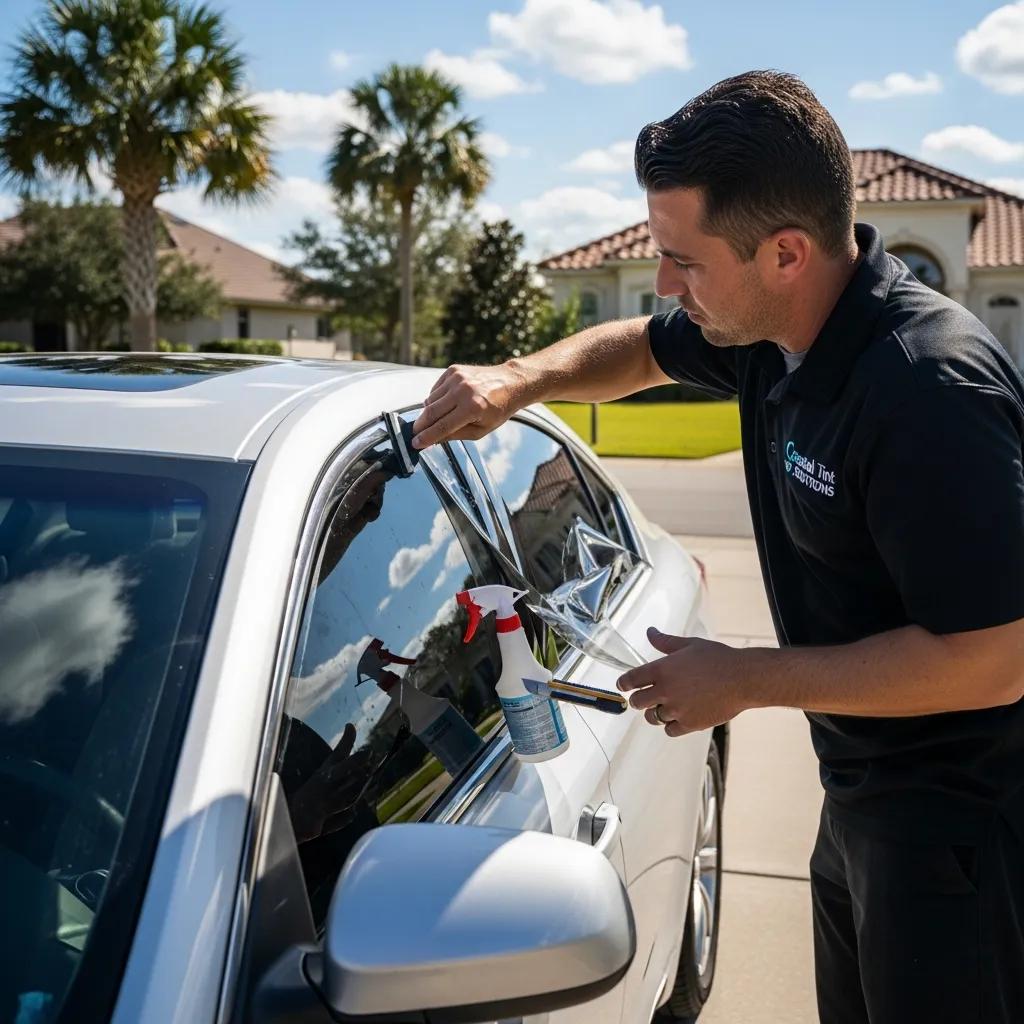
Tint does not last forever. Cheap film especially. If your windows have gone purple, if there are bubbles you cannot push out, or if the edges are curling away from the glass, the film is finished — and no amount of cleaning brings it back.
The good news is that removal is straightforward for a professional, and usually quick. The bad news is that the rear window is where DIY attempts go expensive, and it is the one people always try first.
Here is what removal actually involves, what it costs, and how to decide whether to strip it or replace it.
How to Tell Your Tint Is Done
Two failure modes, two different causes:
Purple film. This is the signature of cheap dyed tint. The dye is the only thing doing the work, and UV breaks it down over time — the blue pigments fade out first, leaving the purple behind. Once it starts, it is irreversible. Ceramic and carbon films do not do this, because they do not rely on dye.
Bubbles and blisters. These are adhesive failure. The glue layer has broken down and released from the glass, and air has moved in. Unlike the water pockets you see in the first week after a fresh install, these do not shrink and do not resolve. If a bubble has held its shape for months, the film is failing.
Also on the list: hazy or milky film that never cleared, edges peeling away from the door seal, and scratches or gouges deep enough to catch a fingernail. Any of those and you are looking at replacement, not repair.
Worth knowing: you cannot patch a section of failing film. Film ages as a sheet. A new piece next to an old one will not match in color or clarity, and the old adhesive next to it is on the same clock. Do the window — usually the whole vehicle.
Remove, or Remove and Replace?
Removal on its own makes sense if you are selling the car, if the tint was illegal and you got a citation, or if you simply want clear glass back.
For most people the answer is remove and replace, for a practical reason: the labor is already happening. Stripping old film and cleaning the adhesive is the bulk of the work, and most shops — us included — discount or waive removal when it is bundled with a new install. Paying for removal today and installation next month means paying for the same prep twice.
If your old film was dyed and you are in Florida, this is also the moment to move up. Ceramic film costs more, does not contain dye, and will not put you back in this position in three years.
What Does Window Tint Removal Cost?
Pricing varies by shop and vehicle, but typical market ranges look like this:
Job | Typical range |
|---|---|
A single side window | $25–$50 |
Two front doors | $40–$80 |
Rear window only (defroster) | $60–$125 |
Full vehicle | $100–$250 |
Removal bundled with new tint | Often discounted or included |
What moves the number: how old the film is (older adhesive is more stubborn), whether it is a factory-laminated film or aftermarket, the number and shape of windows, and above all whether the rear defroster is involved.
Removal on a typical sedan runs one to three hours. Badly degraded film on a vehicle that has baked in the Florida sun for a decade takes longer, because the film tears into small pieces instead of pulling in sheets.
The Rear Window: Where DIY Goes Wrong
This is the part worth reading twice.
Your rear window has the defroster grid bonded directly to the inside surface of the glass — those thin horizontal lines. They are a printed conductive circuit sitting on the glass, and the tint film is stuck on top of them.
Scrape the film off with a razor blade and you will lift the defroster lines with it. Break the circuit and that section stops heating. There is repair paint sold for this, and it works about as well as you would expect. Otherwise you are replacing the rear glass, which costs several times what a professional removal would have.
This is why professionals use steam on rear windows rather than blades. Steam softens the adhesive so the film peels away in one piece with the defroster grid left intact. It is slower and it is why the rear window carries a higher price — that price is buying you an undamaged circuit.
If you take nothing else from this page: do not put a blade to your rear window.
How Professional Removal Works
Heat the glass. Steam or a controlled heat source softens the adhesive without cooking the film into a mess.
Lift a corner and pull slow. Done right, film comes off in large sheets. Pulling fast tears it and leaves adhesive behind.
Clear the adhesive. Whatever glue stays on the glass gets softened and lifted with plastic tools, never metal on a defroster.
Clean and inspect. Glass gets fully decontaminated — essential if new film is going on, since anything left behind shows up as a bump under the new install.
Protect the interior. Door panels and electronics get covered. Steam and water plus door speakers is a combination worth taking seriously.
The DIY Methods, Honestly
People try three approaches. Here is what each actually costs you.
Ammonia and black trash bags in the sun. Spray ammonia on the film, tape bags over it, park in the sun for a few hours. It genuinely softens the adhesive. It also fills your car with ammonia fumes, and ammonia damages leather, vinyl, and any surrounding film you were planning to keep. Ventilate hard, or skip it.
Fabric steamer. The safest DIY option and the closest to how professionals work. It is slow — budget most of a day for a full car — and a household steamer runs out of steam long before you run out of window.
Heat gun and a razor. Fast on side glass in skilled hands. On the rear window this is how defroster grids die. Too much heat in one spot can also stress the glass.
Where DIY usually goes sideways is not the film — it is the adhesive. Getting the film off is the easy half. Getting every trace of glue off without scratching the glass, on five or six windows, is what turns a Saturday afternoon into a weekend and then into a phone call to a shop anyway.
Why Florida Is Hard on Tint
Cheap film fails faster here than almost anywhere, and there is nothing mysterious about why. Dyed film dies from UV exposure, and the Gulf Coast delivers intense UV nearly year-round with very little winter reprieve. Add cars that sit outside in 95-degree heat and the adhesive gets a hard life too.
The practical consequence: film that a shop in Ohio might get eight years out of can go purple here in three. If your last tint job failed early, it was probably the film, not the installer — and the fix is a better film rather than a different shop. Our ceramic vs carbon vs dyed comparison lays out the differences.
Frequently Asked Questions
How much does window tint removal cost?
Typically $25 to $50 for a single side window and $100 to $250 for a full vehicle, depending on the film's age and condition. The rear window costs more because of the defroster. Many shops discount or include removal when you are getting new tint installed.
Will removing tint damage my rear defroster?
It can, if it is done with a blade. The defroster lines sit on the inside of the glass underneath the film, and scraping lifts them. Steam removal leaves them intact, which is why professionals use it on rear glass.
How long does tint removal take?
One to three hours for a typical sedan. Old, brittle, sun-baked film takes longer because it tears into small pieces rather than peeling off in sheets.
Why did my window tint turn purple?
It was dyed film, and UV broke the dye down. The blue pigment fades first and leaves purple behind. It cannot be reversed or cleaned off — the film has to come off. Ceramic and carbon films do not use dye and do not do this.
Can I just replace the bubbling window instead of all of them?
You can, but it rarely looks right. New film will not match the color or clarity of aged film beside it, and the remaining old film is on the same timeline. Most people end up doing the whole vehicle.
Can I remove window tint myself?
On side windows, carefully, yes — a fabric steamer is the safest method. On the rear window with a defroster, the risk is real and the downside is replacing the glass. That one is worth handing to someone with a steamer and practice.
Getting It Off and Doing It Right
We remove old film every week — bubbling, purple, DIY jobs that went wrong, and tint that was too dark for Florida's legal limits and earned a citation. Rear windows get steam, never blades.
If you are replacing the film as well as removing it, tell us when you book — that is where the value is, and we would rather do the whole job once. See our automotive window tinting options, or read the questions worth asking any tint shop before you commit.
Ready to get that old film off? Request a free quote or call (850) 930-1195 — we come to you across Navarre, Gulf Breeze, Pensacola, Fort Walton Beach, and Destin.