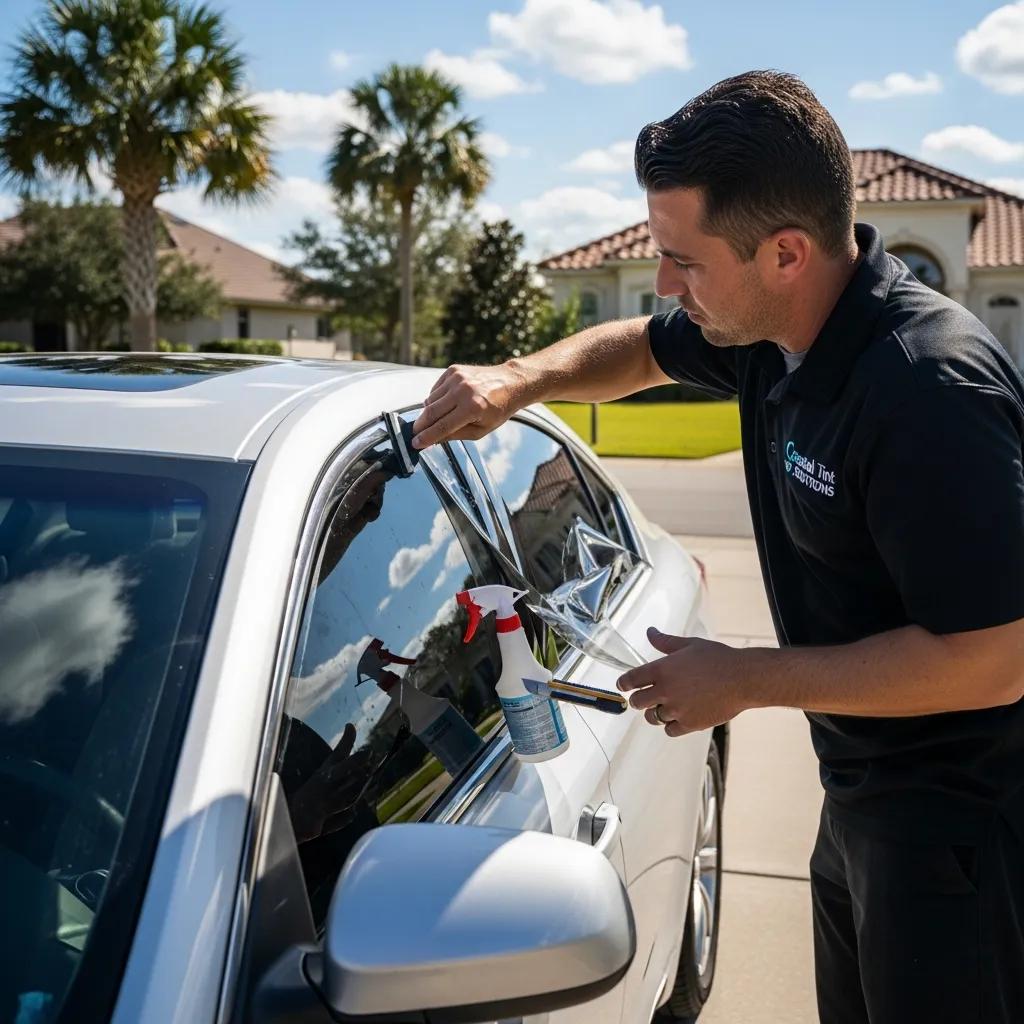
In Florida, the legal window tint limit is 28% VLT on the front side windows for every vehicle. Behind the driver it depends on what you drive: 15% VLT for cars and sedans, 6% VLT for SUVs, trucks, and vans. Those numbers come straight from Florida Statutes 316.2953 and 316.2954, and they have not changed for 2026.
If you take one thing from this page, make it this: Florida does not allow unlimited tint on the back windows of an SUV. You will find plenty of tint-law pages online claiming SUVs and trucks have "no darkness restriction" behind the driver. That is wrong, and it is the single most common piece of misinformation about Florida tint law. The statute sets a 6% floor. Anything darker is illegal, and — as you will see below — the shop that installs it is committing a crime, not just a traffic violation.
Here is what the law actually says, window by window, plus the parts most guides skip: how VLT is really measured, what happens to the installer, and how the medical exemption works.
Florida Tint Limits at a Glance
VLT stands for Visible Light Transmission — the percentage of light the window lets through. Lower number means darker tint. A 5% tint is very dark; a 70% tint is barely noticeable.
Window | Cars & Sedans | SUVs, Trucks & Vans |
|---|---|---|
Windshield | Transparent strip above AS-1 line only | Transparent strip above AS-1 line only |
Front side windows | 28% VLT minimum | 28% VLT minimum |
Back side windows | 15% VLT minimum | 6% VLT minimum |
Rear window | 15% VLT minimum | 6% VLT minimum |
Max reflectivity (front sides) | 25% | 25% |
Max reflectivity (behind driver) | 35% | 35% |
Front Side Windows: 28% for Everyone
Statute 316.2953 covers the windows next to and forward of the driver's seat. The material must have "a light transmittance of at least 28 percent in the visible light range" and "a total solar reflectance of visible light of not more than 25 percent as measured on the nonfilm side."
This applies to every vehicle on Florida roads — sedan, pickup, Suburban, Sprinter van. There is no vehicle class that gets darker front windows. If a shop offers to put 20% on the front of your truck because "trucks are different," they are describing a different state's law.
Behind the Driver: 15% for Cars, 6% for SUVs and Trucks
This is where vehicle class matters, and where most of the confusion lives. Statute 316.2954 sets 15% VLT as the minimum for the back side windows and rear window of a standard passenger car. It then adds that film with "a light transmittance of at least 6 percent in the visible light range may be used on multipurpose passenger vehicles."
A multipurpose passenger vehicle is defined in 316.2951 as a vehicle carrying ten people or fewer that is "constructed either on a truck chassis or with special features for occasional off-road operation." In practice that covers most SUVs, pickups, and full-size vans. Your Tahoe, F-150, and Odyssey qualify. Your Camry does not.
So SUVs and trucks do get meaningfully darker rear glass than cars — 6% versus 15% is a big visual difference. What they do not get is unlimited darkness. 5% "limo" tint is below the 6% floor and is illegal on any vehicle in Florida, front or back.
One more rule people miss: under 316.2954(2), if your rear window is treated with anything that makes it nontransparent, the vehicle must have working side mirrors on both sides.
Windshield Rules: "Transparent" Is the Key Word
Statute 316.2952 allows sunscreening material "along a strip at the top of the windshield, so long as such material is transparent and does not encroach upon the driver's direct forward viewing area" — the AS-1 zone defined by Federal Motor Vehicle Safety Standard No. 205. Most windshields have a small "AS-1" marking etched near the top edge showing where that line falls.
Two details worth knowing. First, the strip must be transparent — the statute says so explicitly, which rules out an opaque or heavily darkened brow strip even above the line. Second, the law is generally restrictive about anything on the windshield at all; the short list of permitted exceptions covers required certificates and stickers, that transparent sun strip, toll transponders, and GPS or satellite navigation devices.
A full-windshield clear ceramic film is a gray area that enforcement treats inconsistently. If you are considering one, ask your installer directly how it measures and get the VLT reading in writing.
Reflectivity and Color
Darkness is not the only limit. Front side windows are capped at 25% total solar reflectance, and windows behind the driver at 35%. This is what rules out the mirror-finish look — a film can pass the VLT test and still be illegal because it is too reflective.
On color: Florida's statutes regulate transmittance and reflectance rather than listing banned colors, but metallic and mirrored films are the practical casualties of the reflectance caps. If you want a colored or mirrored look, get the specific film's certified reflectance numbers before it goes on the glass.
How VLT Is Actually Measured (The Part That Catches People Out)
Here is the trap. The statutes say the material is tested "when applied to and tested on the glass of such windows on the specific motor vehicle." That means the legal reading is film plus factory glass together, not the film alone.
Factory automotive glass is not clear. Most side glass comes from the manufacturer somewhere around 70–80% VLT before anything is applied. So if you put a film sold as "35%" onto glass that is already at 75%, the combined reading lands near 26% — under the 28% limit, and a ticket, even though the box said 35%.
This is why a shop that knows Florida law will meter your specific glass before recommending a film, and why the same film can be legal on one vehicle and illegal on another. When you get a quote, ask what the measured result will be on your car, not what the film is labeled. Any installer who cannot answer that is guessing.
Penalties: The Driver Gets a Ticket, the Installer Gets a Misdemeanor
Under 316.2956, driving with illegal tint is "a noncriminal traffic infraction, punishable as a nonmoving violation." No points on your license. Fines vary by county, and in many cases an officer will write a correctable citation that gets dismissed once you remove the film and show proof.
The shop is a different story. The same statute makes it a second-degree misdemeanor to sell or install illegal sunscreening material. That is a criminal charge, not a traffic ticket.
Worth sitting with for a second: any shop willing to put 5% on your front windows is knowingly committing a crime to make a sale. It tells you what their warranty is likely worth, and what happens when your film bubbles in year two.
Is 5% Limo Tint Legal in Florida?
No. Not on any window, on any vehicle. The darkest legal tint in Florida is 6% VLT, and only on the windows behind the driver of an SUV, truck, or van. For a car it is 15% behind the driver. For anyone's front side windows it is 28%.
Limo tint is legal on an actual limousine and on some commercial vehicles under separate provisions — which is where the confusion starts. On a personal vehicle, 5% is not a legal option in this state.
Is Ceramic Tint Legal in Florida?
Yes. Florida's statutes regulate how much light passes through and how much reflects back — not what the film is made of. Ceramic window tint is available in every legal shade, and because it blocks infrared heat rather than relying on darkness, it is usually the better answer for Florida drivers anyway. A 35% ceramic film will keep a cabin cooler than a 20% dyed film while staying comfortably legal.
Ceramic is also metal-free, so it clears the reflectance limits easily and will not interfere with GPS, cell, or radio signal.
20% vs 35%: What It Looks Like at Night
A question we get constantly at the shop, and the honest answer is that legality and comfort are different questions.
35% is a noticeable tint that most drivers find comfortable after dark. 20% is dark enough that backing out of an unlit driveway or reading a poorly marked road at night takes real adjustment, especially for drivers over about 50, whose eyes need more light. 15% and below on side glass you will drive with your window down at night.
On the Gulf Coast there is a second factor: salt haze and headlight glare off wet asphalt after an afternoon storm. If you drive Highway 98 at night, that argues for staying lighter on the front and putting the darkness in the back where it does not affect your sightlines.
Medical Exemptions
Florida does allow darker tint for medical reasons under 316.29545. The statute names "lupus, any autoimmune disease, or other medical conditions which require a limited exposure to light."
The exemption is issued by the Department of Highway Safety and Motor Vehicles, which consults its Medical Advisory Board on qualifying conditions. The certificate is tied to a specific vehicle — it lists the make, model, year, VIN, decal number, and registered owner — and it is nontransferable. Sell the car and the exemption is void. You will need a physician's certification to apply, and the department may charge a fee.
Two practical notes: apply before you have the tint installed, not after you are pulled over, and keep the certificate in the vehicle.
Out-of-State Vehicles
Florida's limits apply to vehicles operated on Florida roads. A car registered in a state with looser rules is not automatically exempt, and this catches out seasonal residents and military families arriving at Hurlburt Field or NAS Pensacola with tint that was legal where they came from.
If you have just moved here and your windows are darker than these limits, get them metered before you register the vehicle.
Frequently Asked Questions
What is the darkest legal tint in Florida?
6% VLT, and only on the windows behind the driver of an SUV, truck, or van. For cars it is 15% behind the driver, and 28% on the front side windows of every vehicle.
Did Florida window tint law change in 2026?
No. The limits in statutes 316.2951 through 316.2956 are unchanged — 28% front, 15% rear for cars, 6% rear for multipurpose vehicles. Any page advertising "new 2026 tint laws" is describing the same rules that have been in place for years.
Do SUVs really have no tint limit on the back windows in Florida?
No, and this is the most common myth about Florida tint law. Multipurpose passenger vehicles get a lower floor of 6% VLT behind the driver, not unlimited darkness. Several national tint-law sites state this incorrectly.
How much is a window tint ticket in Florida?
It is a noncriminal, nonmoving violation, so there are no license points. The fine varies by county, and many jurisdictions will dismiss a first offense as a correctable citation once you remove the film and show proof of compliance.
Can I get 20% tint all around in Florida?
Not legally. 20% is below the 28% front-window minimum, so it fails on the front regardless of vehicle. It is legal on the back of a car (above the 15% floor) and on the back of an SUV or truck.
Will my factory glass count against my tint percentage?
Yes. The statute measures the film and the glass together, and factory glass is typically 70–80% VLT on its own. A 35% film on 75% glass meters around 26%, which is illegal on a front window. Always ask for the measured result on your specific vehicle.
Get It Right the First Time
Every film we install is metered on your vehicle's glass, so the number on your invoice is the number a trooper's meter will read. We have been tinting on the Emerald Coast since 2013, and we would rather talk you into a legal shade than take your money twice.
See our automotive window tinting options, compare film types in our ceramic vs carbon vs dyed breakdown, or check which tint percentage is right for Florida driving. When you are ready, request a free quote or call (850) 930-1195 — we come to you across Navarre, Pensacola, Gulf Breeze, Fort Walton Beach, and Destin.
This page explains Florida law as of August 2026 and is general information, not legal advice. For your specific situation, consult the current text of Florida Statutes 316.2951 through 316.2956 or an attorney.