A good tint job lasts a decade. A bad one is visible within a season and costs more to fix than it did to buy, because the failed film has to come off before anything new goes on.
The difference is not the price on the quote. It is the film, the installer, and whether the shop is willing to tell you no. Here is what to actually check.
1. Ask What Film They Install — By Name
The first question, and the most revealing. A shop that installs quality film will name the manufacturer and the series without hesitating. A vague answer about "premium film" usually means whatever was cheapest that month.
What you want to hear is carbon or ceramic. Dyed film is the cheap tier, and in Florida sun it fades, turns purple, and starts bubbling at the edges within a few years. Our film type comparison covers the differences honestly.
Then ask about the warranty specifically: does it cover fading, bubbling, and peeling, for life? Professional-grade film comes with that from the manufacturer. If a shop cannot offer it, the film is the reason.
2. Ask Whether They Meter Your Glass
This is the question almost nobody asks, and it separates a professional from a guesser faster than anything else.
Florida's legal limit is measured on film and factory glass together, not on the film alone. Your factory glass already blocks light before anything goes on it — typically it transmits around 70 to 80% — so a film labeled 35% can meter under the legal limit once installed on your specific vehicle.
A shop that quotes you a percentage without putting a meter on your glass is guessing with your ticket. Ours measures first. The full rules are in our Florida window tint law guide.
Worth knowing where the risk actually sits: if you get pulled over, the driver's citation is a nonmoving violation. But under Florida law, installing or selling non-compliant film is a second-degree misdemeanor — for the shop. Any installer happy to put illegal film on your car is gambling their own license and handing you the ticket. That willingness tells you everything about how they will handle the rest of the job.
3. Look at the Installer's Actual Work
Great film in inexperienced hands still comes out badly. The technique matters as much as the material.
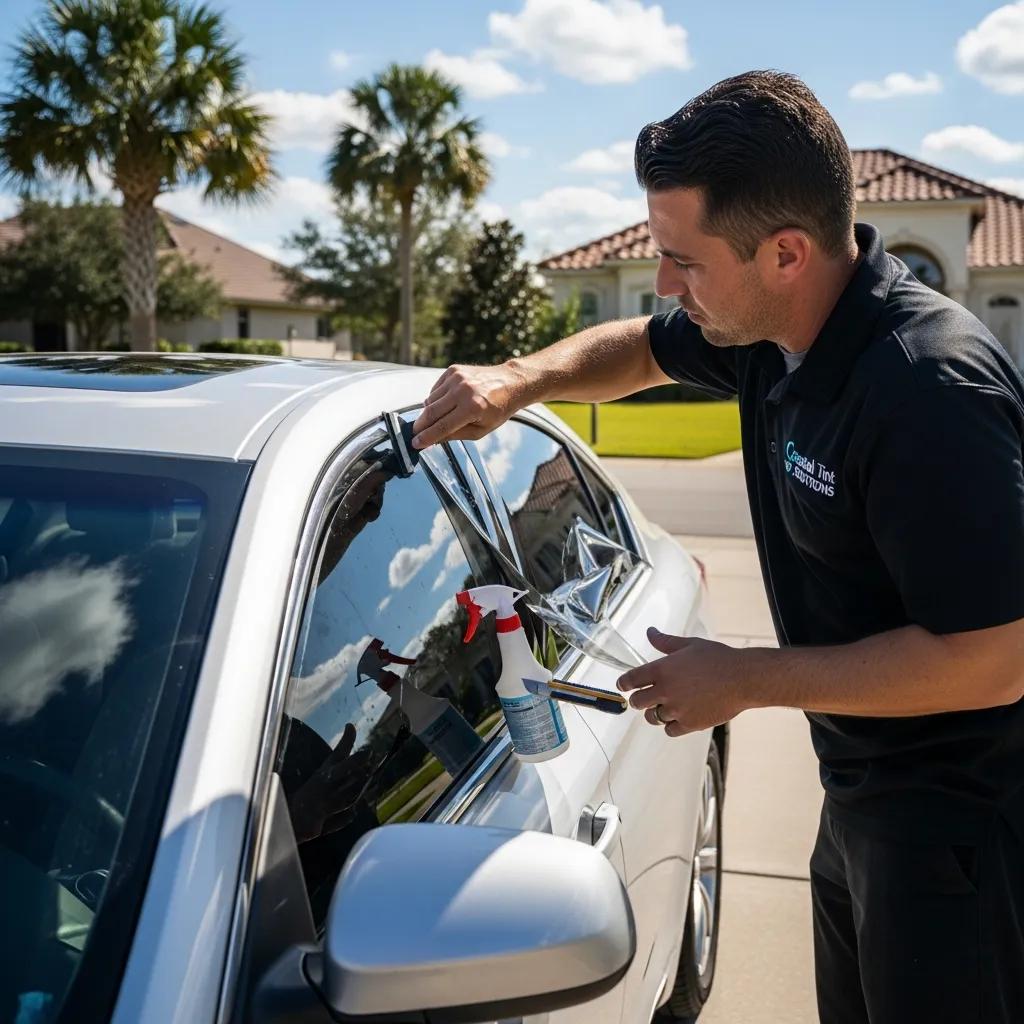
Ask to see recent vehicles. Look at the edges. Clean, tight, following the curve of the glass, with no light gap along the top of the door glass. Look for trapped dust or hair under the film — contamination is the mark of a dirty install space.
Ask how they cut. Computer-cut patterns are cut from a database to your exact make and model, which means no blade ever comes near your glass or your door seals. Hand-cutting on the vehicle is faster for the shop and riskier for you.
Ask about the rear window. It is the hardest piece on any vehicle — a compound curve that has to be heat-shrunk to fit. It is where inexperience shows first. Browse our gallery and then ask to see somebody else's.
4. Read the Reviews Properly
The star average is the least useful number on the page. Read for consistency instead.
Twenty reviews independently mentioning clean edges and on-time pickup tells you more than one glowing paragraph. Pay attention to how the shop responds to the occasional bad review, too — a business that fixes problems says so publicly. And check the dates: a burst of five-star reviews in one week and nothing since is a pattern worth noticing.
5. Look at Where the Work Happens
Dust is the enemy of a clean tint job, so the install environment is not a detail.
A dedicated, clean bay matters. If the shop offers mobile service — and on the Emerald Coast most people want it — ask how they control contamination in a driveway. There is a real answer to that question involving prep, water, and working conditions, and a shop that has one will give it to you. Here is how ours works.
Four Myths Worth Clearing Up
"Darker means cooler." It does not, and this is the most expensive misunderstanding in the trade. Darkness controls visible light. Heat is mostly infrared, which is a separate part of the spectrum. A light ceramic film can reject far more heat than a dark dyed one — which is fortunate, because Florida caps your front windows at 28% regardless.
"All ceramic tint is the same." The word is unregulated. Ask for the total solar energy rejected figure rather than infrared rejection — infrared numbers are often measured at a single flattering wavelength and look far more impressive than the film performs.
"Tint blocks your cell signal." Old metallic films did. Ceramic film contains no metal and does not interfere with GPS, cell, radio, or tire pressure sensors.
"Bubbles mean a bad install." Not in the first week. Small water pockets and slight haze while the film cures are normal, especially in Gulf humidity — see our curing guide for what is normal and what is not. Bubbles that are still there after a month are a different matter.
The Red Flags
Walk away if a shop will not name the film, cannot produce a written lifetime warranty, offers to install film darker than Florida allows, quotes a shade without metering your glass, or gives you a price that moves after the work is done.
A few more questions worth bringing with you are in our list of questions to ask before you tint.
Frequently Asked Questions
What should I ask a window tint shop before booking?
What film brand and series they install, whether the warranty covers fading, bubbling, and peeling for life, whether they meter your glass for legal compliance, and whether they use computer-cut patterns.
How do I know if a tint shop is any good?
Look at recent work in person for clean edges and no trapped dust, read reviews for consistency rather than the star average, and see whether they will tell you no — a shop that talks you out of an illegal shade is protecting you.
Is a lifetime warranty on window tint real?
Yes, from professional-grade film manufacturers, and it typically covers fading, bubbling, peeling, and delamination for as long as you own the vehicle. Get it in writing and check whether it covers labor for a re-install.
Should I choose a mobile tinter or a shop?
Either, if they control contamination properly. Ask how they manage dust on site. Mobile is the same install quality when it is done right, and it saves you most of a day.
Why is one tint quote so much cheaper than the others?
Usually dyed film, no warranty, or both. A cheap install that fails in three years costs more than doing it once, because you pay for removal as well as the replacement.
Come Ask Us These Questions
We would rather you arrive with this list than without it. We will tell you what film we use and why, meter your glass in front of you, and quote a firm price before anything starts.
And if the honest answer is that you do not need the upgrade you came in asking for, we will say that too.
Come by the shop at 8645 Navarre Parkway, request a free quote, or call (850) 930-1195. See our automotive, residential, and ceramic tinting, or check pricing.